Fluid Definition Module
In this module, the user inputs the fluid definition for a given well. The fluid definition is used consistently across different modules of the software, where the fluid is the same for all calculations for a given well.
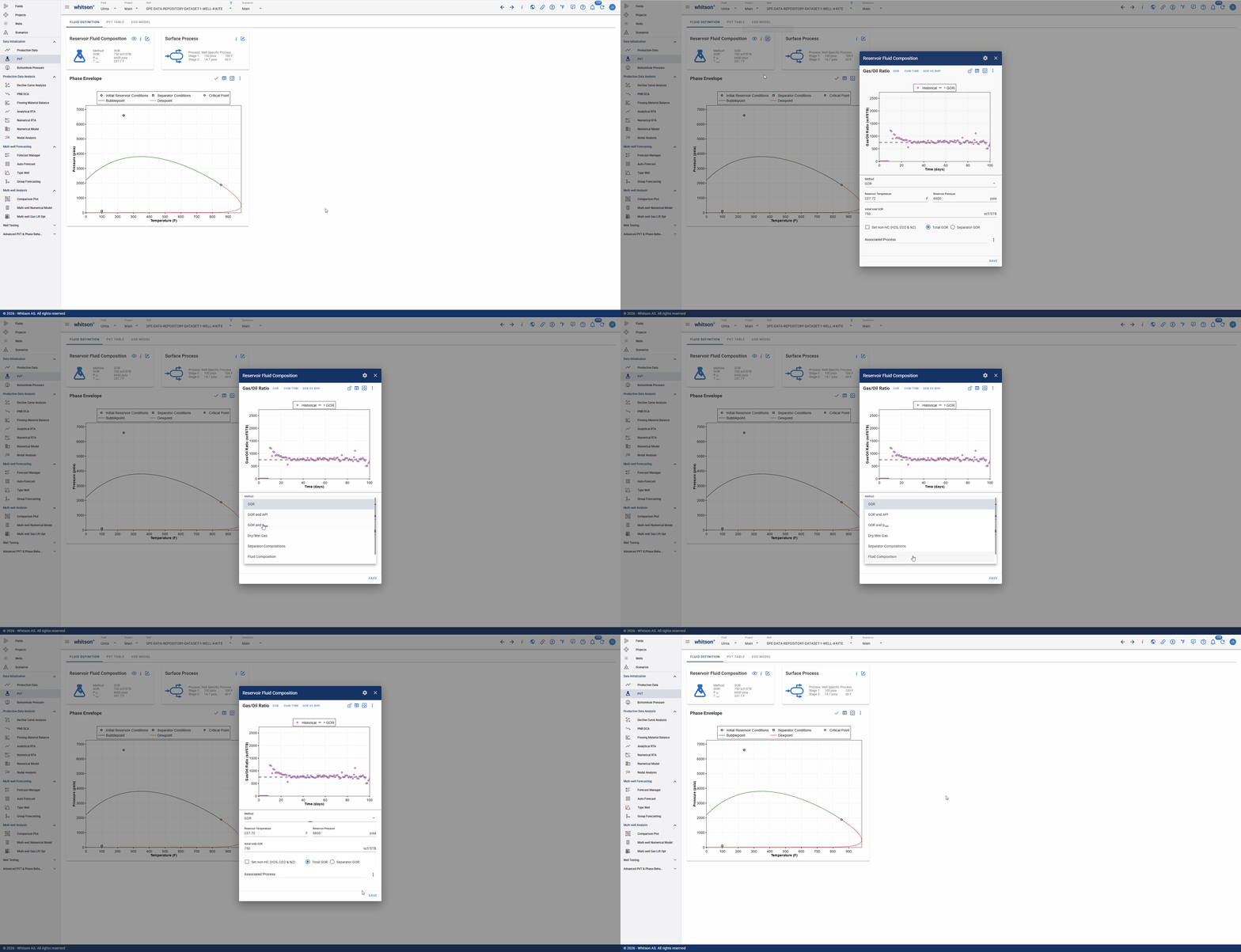
There are seven methods for defining the in-situ fluid of a well in whitson+:
| Available Data | Method Description |
|---|---|
| Initial GOR | whitson+ calculates the initial composition based on initial GOR, the EOS model for the field / basin, and a set of samples or seed feeds from the same field / basin. |
| Initial GOR and stock tank API | whitson+ calculates the initial composition based on initial GOR, API, the EOS model for the field / basin, and a set of samples or seed feeds from the same field / basin. |
| Initial GOR and saturation pressure | whitson+ calculates the initial composition based on initial GOR, PSAT, the EOS model for the field / basin, and a set of samples or seed feeds from the same field / basin. |
| Dry/Wet gas | whitson+ uses the input composition up to \(C_{6+}\) and splits the \(C_{6+}\) pseudo fraction using an exponential model based on the input \(C_{6+}\) MW to generate the composition in the component slate of the EOS model. |
| Separator oil and gas compositions | whitson+ calculates the initial composition using the measured separator oil and separator gas compositions, their corresponding initial producing separator GOR, the EOS model for the field / basin, and a set of samples or seed feeds from the same field / basin. |
| Fluid composition | whitson+ uses the specified composition as the composition of the well. |
| Separator oil correction | whitson+ estimates the wellstream composition to match measured flashed oil and gas compositions, flashed oil density, and separator GOR using a basin-specific model. This method is designed specifically for the Uinta basin and requires the Uinta EOS. |
Which method should be chosen for a given well?
We recommend using as much of the available data as possible, as long as the data is quality-checked and deemed appropriate for use in the calculations. The minimum input needed for a given well is the GOR, but for accurate predictions of the fluid, we recommend also providing a stock tank oil API, which is easily obtained through field sampling.
The more data that becomes available, the more accurate the calculated initial reservoir composition should become. For further details about the data and the accuracy of the methods, see the methodology for wellstream composition estimation.
1. Initial GOR
whitson+ calculates the initial composition based on initial GOR, the EOS model for the field/basin, and a set of samples from the same field / basin. The GOR can be a total GOR or a GOR at separator conditions.
1.1. Required Input Data
The data required to define the fluid in this case are:
- Initial GOR
- Reservoir temperature
- Initial reservoir pressure
- Surface process associated with the well, or with the GOR time of sampling
- (optional) Amounts of non-hydrocarbons
Understanding Process vs. Separator GOR
The GOR can be a separator GOR or a full process GOR.

1.2. Estimation of the Initial Reservoir Fluid
The Regression on Fg method is used to estimate the in-situ reservoir composition \(z_{i}\).
2. Initial GOR and stock tank API
whitson+ calculates the initial composition based on initial GOR, API, the EOS model for the field / basin, and a set of samples from the same field / basin.
2.1. Required Input Data
The data required to define the fluid in this case are:
- Initial GOR (total process GOR or GOR at first-stage separator)
- Initial stock tank oil API
- Reservoir temperature
- Initial reservoir pressure
- Surface process associated with the well, or with the GOR time of sampling
- (optional) Amounts of non-hydrocarbons
Why Isn't Gas Specific Gravity a Required Input?
Many conventional PVT correlations (e.g., correlations given by Standing) require gas specific gravity as an input. Hence, some people might wonder why gas specific gravity is not needed as an input here. The short answer is that when developing this method, we did not find consistently better results when incorporating gas specific gravity as an input. This is because fluid type is not as strongly correlated with gas specific gravity as it is with GOR and API, as seen in Table 2.1 in the SPE Phase Behavior.
Additionally, there is no need to have this additional data point, as it is already "implicitly" provided/constrained by the already available input data. How? Separator gas specific gravity can be calculated from the separator gas compositions. Separator gas compositions are found by multiplying the equilibrium ratios (K-values = \(yi/xi\)) provided by the EOS model with the separator oil composition. The separator oil composition is estimated from the liquid API and separator conditions.
Non-Hydrocarbon Handling in Calculated Compositions
If the amounts of non-hydrocarbons are not specified by the user, the calculated composition will inherit these amounts from the selected seed feed composition, which are generally average values in the given field or basin. We recommend specifying these amounts if the variation in non-hydrocarbon amounts is large in your field to provide an accurate description of these components in the calculated composition.
2.2. Estimation of the Initial Reservoir Fluid
The API Interpolation / Fg regression method is used to estimate the in-situ reservoir composition \(z_{i}\).
3. Initial GOR and Saturation Pressure
whitson+ calculates the initial composition based on initial GOR, PSAT, the EOS model for the field / basin, and a set of samples from the same field / basin.
3.1. Required Input Data
The data required to define the fluid in this case are:
- Initial GOR (total process GOR or GOR at first-stage separator)
- Saturation pressure
- Reservoir temperature
- Initial reservoir pressure
- Surface process associated with the well, or with the GOR time of sampling
- (optional) Amounts of non-hydrocarbons
3.2. Estimation of the Initial Reservoir Fluid
The PSAT Interpolation / Fg regression method is used to estimate the in-situ reservoir composition \(z_{i}\).
4. Dry or Wet Gas
whitson+ calculates the initial composition based on either the specified dry/wet gas specific gravity or the reservoir fluid composition up to \(C_{6+}\) and the input \(C_{6+}\) MW.
4.1. Required Input for Simplified Input (SG)
- Reservoir temperature
- Reservoir pressure
- Gas Specific Gravity (SG)
- Measured composition of \(N_2, CO_2, H_2S\)
4.2. Required Input Data for Dry Gas Composition
The data required to define the fluid in this case are:
- Dry/wet gas composition up to \(C_{6+}\)
- Reservoir temperature
- Initial reservoir pressure
- \(C_{6+}\) MW
4.3. Estimation of the Initial Reservoir Fluid using Dry Gas Composition
There is no estimation of the initial reservoir fluid in this case, as the input composition is honored exactly and the total amount of the \(C_{6+}\) fraction is split into heavier fractions (defined in the EOS model) using an exponential molar distribution model based on the \(C_{6+}\) MW.
5. Separator Oil and Gas Compositions
whitson+ calculates the initial composition using the known (measured) separator oil and separator gas compositions, their corresponding initial producing separator GOR, the EOS model for the field / basin, and a set of samples (or seed feeds) from the same field / basin.
5.1. Required Input Data
The data required to define the fluid in this case include:
- Initial separator (well test) GOR
- Measured composition of separator oil and separator gas (up to \(\mathrm{C_{7+}}\))
- \(\mathrm{C_{7+}}\) molecular weights (for both separator oil and separator gas)
- Separator \((p, T)\) conditions
- Reservoir temperature
- Initial reservoir pressure
- (Optional) Stock tank liquid API
An example dataset is provided here in PDF format and here in Excel format.
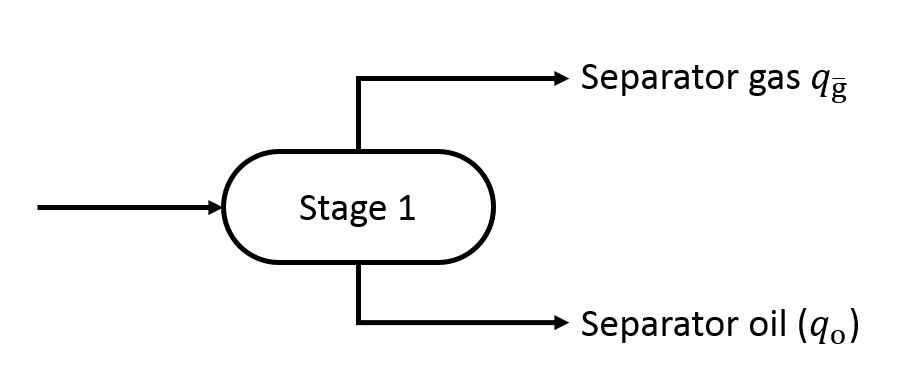
Calculation of Separator GOR
Note that the separator GOR is the "well test GOR" measured right after the separator:
When is stock tank liquid API important?
It is important to note that the stock tank liquid API referred to here is the API measured on the stock tank oil from the single-stage (atmospheric) flash of the collected separator oil in the PVT lab. The calculated composition without stock tank liquid API input should be accurate if the \(\mathrm{C_{7+}}\) of separator oil is reliable from the PVT lab. If the lab-reported separator oil \(\mathrm{C_{7+}}\) is not reliable, then we recommend specifying the measured stock tank oil API. In that case, whitson+ will estimate the \(\mathrm{C_{7+}}\) molecular weight honoring the input API. The estimated \(\mathrm{C_{7+}}\) molecular weight is then used to extend the \(\mathrm{C_{7+}}\) composition to EOS \(\mathrm{C_{N+}}\) (e.g., \(\mathrm{C_{36+}}\)).
Why does whitson+ need separator oil \(\mathrm{C_{7+}}\) molecular weight when the user inputs stock tank liquid API?
Separator oil \(\mathrm{C_{7+}}\) molecular weight is used in whitson+ for two different purposes: (i) converting the lab-reported molar composition to lab measured mass composition and (ii) extending the \(\mathrm{C_{7+}}\) composition to EOS \(\mathrm{C_{N+}}\) (e.g., \(\mathrm{C_{36+}}\)). If the lab \(\mathrm{C_{7+}}\) is not reliable, this would mean that the lab-reported molar composition of separator oil up to \(\mathrm{C_{7+}}\) is wrong because the wrong (unreliable) \(\mathrm{C_{7+}}\) molecular weight was used to convert the reliable measured mass composition to the reported molar composition. Therefore, lab \(\mathrm{C_{7+}}\) molecular weight is always needed (and used) to convert the lab-reported molar composition back to measured mass composition up to \(\mathrm{C_{7+}}\). For (ii), the lab-reported \(\mathrm{C_{7+}}\) molecular weight is used if stock tank oil API is not input; otherwise, the estimated \(\mathrm{C_{7+}}\) molecular weight is used, honoring the input API.
5.2. Estimation of the Initial Reservoir Fluid
The comprehensive separator data matching method is used to estimate the in-situ reservoir composition \(z_{i}\).
6. Fluid Composition
whitson+ uses the specified composition as the composition of the well.
6.1. Required Input Data
The only input required to define the fluid in this case is the fluid composition. The composition should be provided in the same compositional slate as the EOS model associated with the field for the well in question.
6.2. Estimation of the Initial Reservoir Fluid
There is no estimation of the initial reservoir fluid in this case, as the provided composition is already the initial reservoir fluid to be used in the calculation.
7. Separator Oil Correction
The method is designed to obtain a wellstream composition that ensures accurate emission factors for the Uinta basin. The method should only be used for the Uinta basin in connection with the basin-wide EOS model developed by Whitson AS.
Important
The Separator Oil Correction method is only available when the Field is called "Uinta" and the EOS used is "Uinta".
7.1. Required Input Data
The data required to define the fluid in this case include:
- Reservoir Temperature
- Reservoir Pressure
- Separator GOR
- Separator \((p, T)\) conditions
- Flashed Oil Density at \(160^\circ F\)
- \(\mathrm{C_{7+}}\) molecular weights
- Measured composition of flash oil and flash gas (up to \(\mathrm{C_{7+}}\))
7.2. Estimation of the Initial Reservoir Fluid
The method uses reported flashed oil and flashed gas compositions up to \(\mathrm{C_{7+}}\), measured from a flash of separator oil at 1 atm and \(160^\circ F\). The \(\mathrm{C_{7+}}\) part of the flashed oil composition is extended using a basin-wide gamma model with the known \(\mathrm{C_{7+}}\) average molecular weight. \(C_{6-}\) mole-fractions of flashed oil are corrected with a fixed set of (tuned) EOS-based K-values and the known (assumed to be correct) \(C_{6-}\) mole fractions of flashed gas composition (\(x_i = y_i/K_i\)). The split fraction between light and heavy \(\mathrm{C_{7+}}\) components of flashed oil is calculated such that the input flashed oil density at \(160^\circ F\) is matched exactly. \(\mathrm{C_{7+}}\) mole fractions of flashed gas are calculated from \(\mathrm{C_{7+}}\) mole fractions of flashed oil and EOS-based K-values for \(\mathrm{C_{7+}}\) components \((y_i = K_i \times x_i)\).
The corrected flashed oil and flashed gas compositions are recombined to yield a corrected separator oil composition. The recombination fraction is calculated such that the calculated separator oil composition has a bubble-point pressure equal to the input separator pressure at the separator temperature.
The calculated separator oil composition is then recombined with separator gas (the incipient phase of separator oil) to calculate a wellstream composition matching the input (wellstream) separator GOR.
8. Define Surface Process
Each well in whitson+ has a surface process associated with it. This surface process is used in different modules wherever a surface process is required (e.g., black oil tables or defining the in-situ fluid from API and GOR).
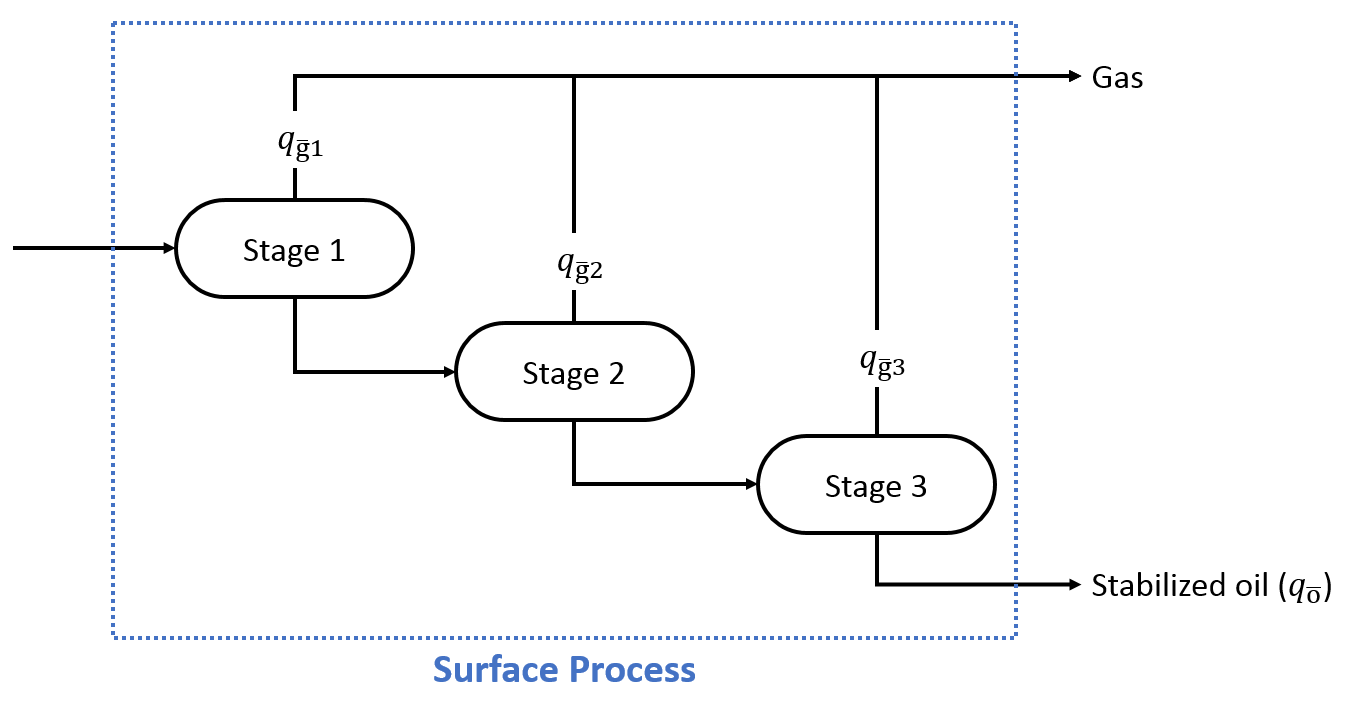
Multiple wells can share the same surface process, and the connection is made through the name of the process. This means that when two wells have the same process name, they are using the same process, and updating the process for one well will also affect the other well.
Wells can be linked to or unlinked from a surface process at any time, and users can change process conditions or the number of stages.
8.1. Associate Process to Time of Sampling
The Associate Process option controls which surface process is used when generating the reservoir fluid composition from production-based methods such as GOR, GOR and API, and GOR and psat.
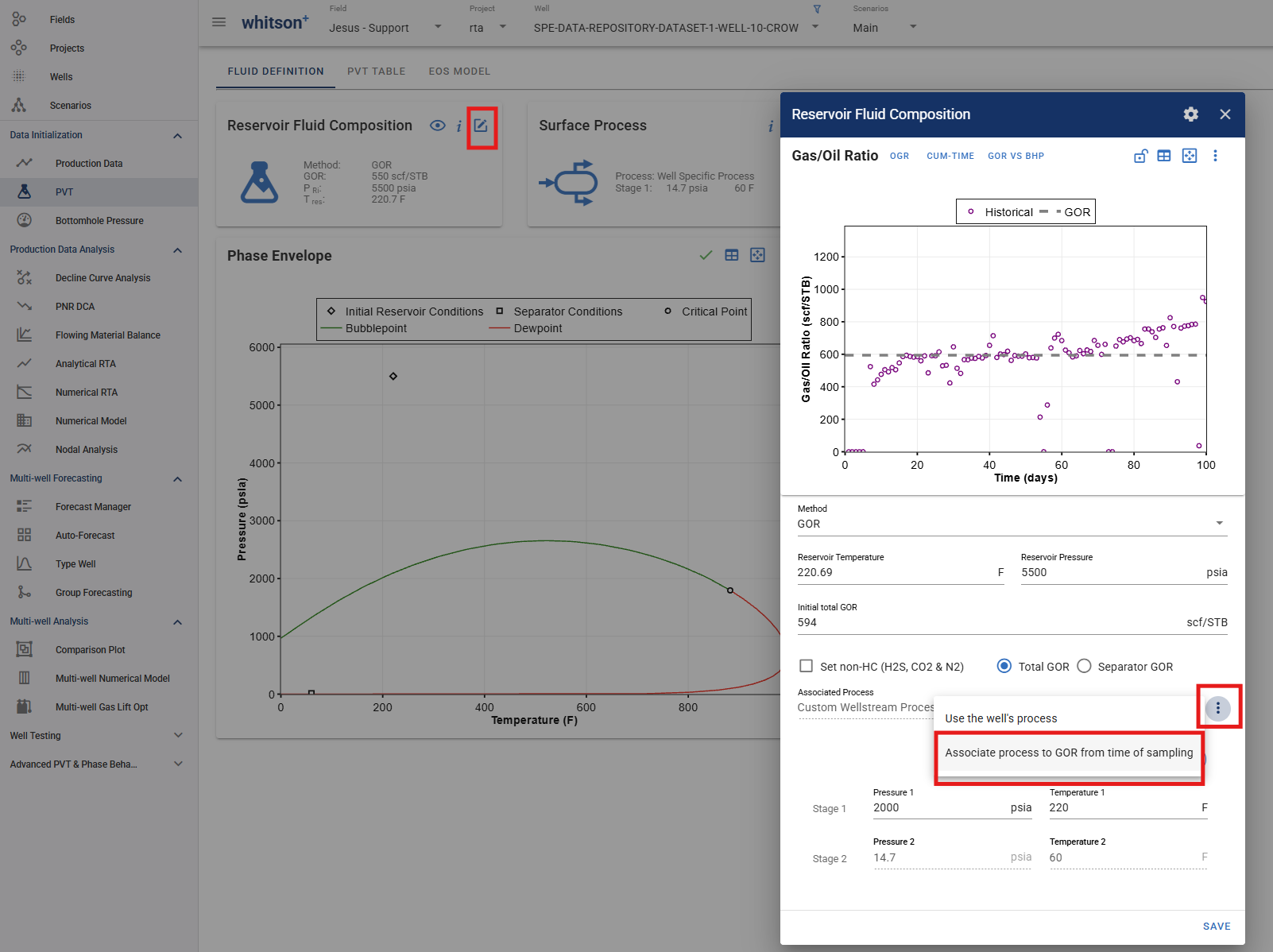
There are two main options:
-
Use the well's process
Uses the surface process that is currently assigned to the well. -
Associate process to GOR from time of sampling
Uses the separator conditions associated with the relevant producing GOR measurement. This allows the composition estimation to reflect the proper separator or surface conditions.
This option only affects the fluid composition generated from the selected GOR-based method. The rest of the software will continue using the well's regular surface process for analysis and forecasting.
This option may be useful when the user wants to define initial separator conditions for the fluid composition while keeping the current separator conditions assigned to the well for the rest of the analysis.
9. Phase Envelope Generation
Given a feed composition (\(z_i\)) and equation of state (EOS) fluid model, a pressure-temperature phase envelope is generated, yielding the pressure-temperature boundary of the two-phase region and the associated fluid type of the boundary (bubble-point or dew-point). In addition to the phase boundary, the phase envelope estimates the critical point (if one exists). To provide a reference for the initial reservoir fluid classification, the initial reservoir conditions are also plotted with the phase envelope.
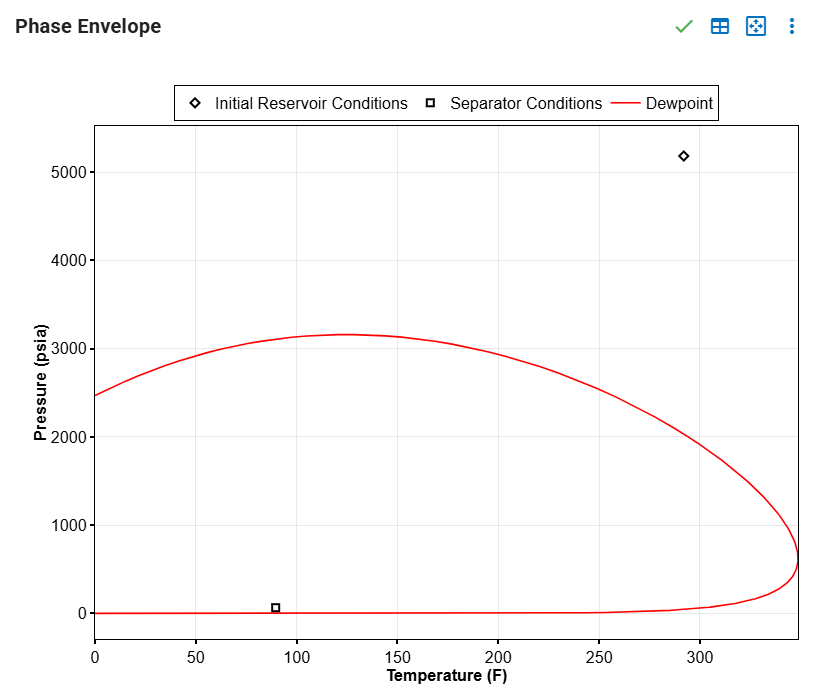
In some cases, particularly when the fluid composition is very light, the phase envelope may appear truncated. This typically occurs in lean gas mixtures or gas condensate systems dominated by light hydrocarbons, where the fluid remains almost entirely in the gas phase across the pressure-temperature range of interest. As a result, a well-defined two-phase region does not form, and only the dew-point curve is visible. The critical point, if it exists, may lie outside the plotted envelope, either at negative temperatures or beyond the left-hand side of the diagram, and therefore may not be displayed within the typical phase envelope plot.
An example of a truncated phase envelope is shown below for reference.
10. Export PVT Properties
10.1. Phase Envelope
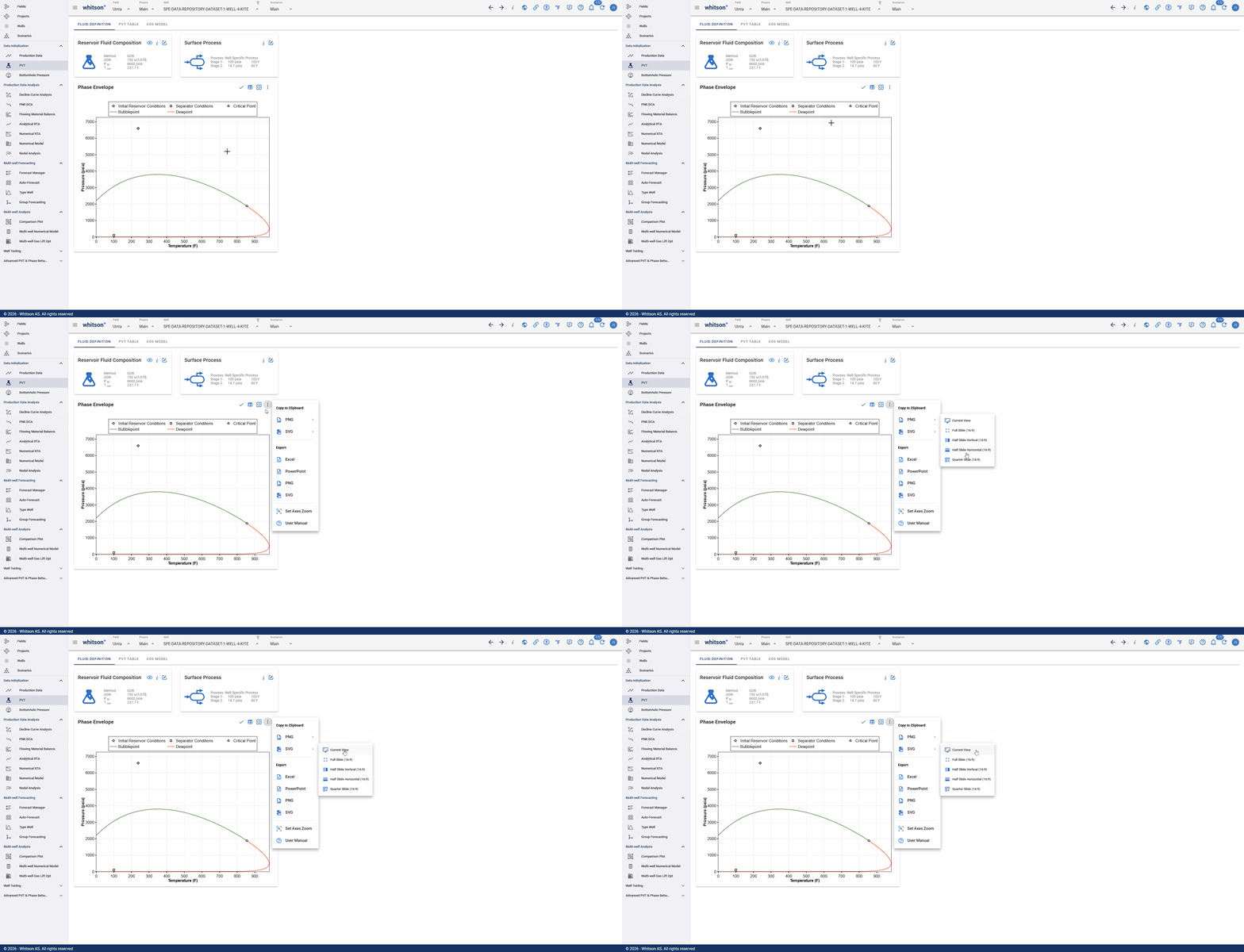
The phase envelope can be exported or copied to clipboard. Clicking the three dots on the top right of the plot provides the option to export or copy as either a PNG or SVG file. PNG files are a standard figure format, while SVG files are vector-format files (e.g., enhanced metafile in Microsoft Office products).
Recommended Format for Microsoft Office Use
If you are planning to use PowerPoint (or other Microsoft Office products), we suggest using the SVG file. The reason for this is that it provides better resolution (because of the vector format).
10.2. Excel
Exporting to well information data automatically generates an Excel file with the data in the phase envelope figure and a separate worksheet with the figure.
To calculate and export PVT properties using the whitson+ EOS for all wells at once:
-
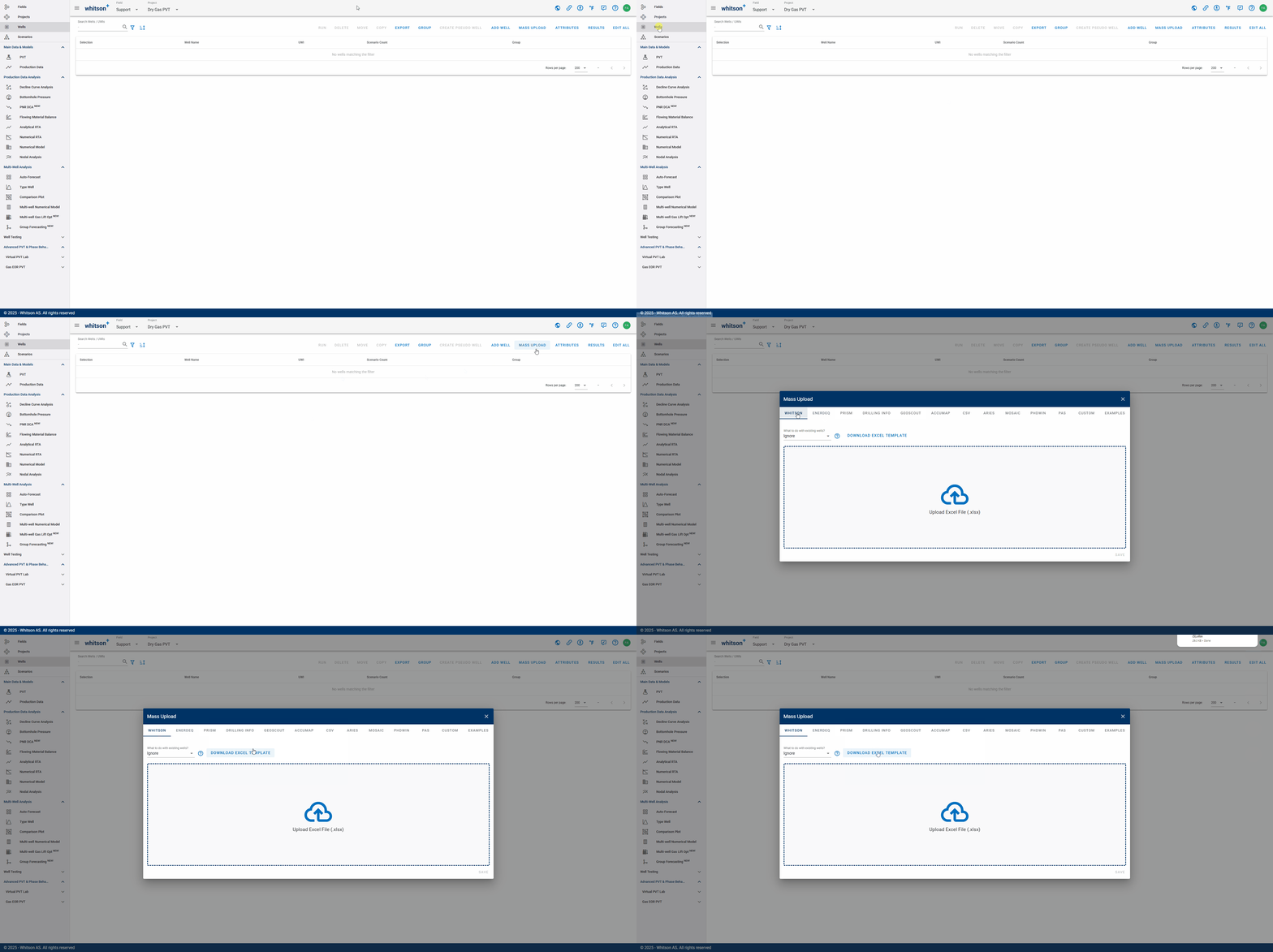
Download the mass upload file: Go to Wells, MASS UPLOAD, WHITSON, and click "DOWNLOAD EXCEL TEMPLATE".
-
Use the sheets that include "Well Data" in the sheet name, and make sure all required fields are populated. Required inputs may include items such as Tres, pRi, and fluid composition, depending on the selected fluid definition method.
Hidden Sheets
Some of the sheets in the Excel template are hidden by default and are dedicated to different fluid definition methods. Unhide the Well Data sheet you need, complete the required fields, and leave the other sheets hidden or unused.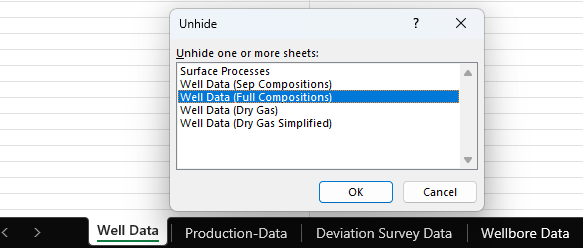
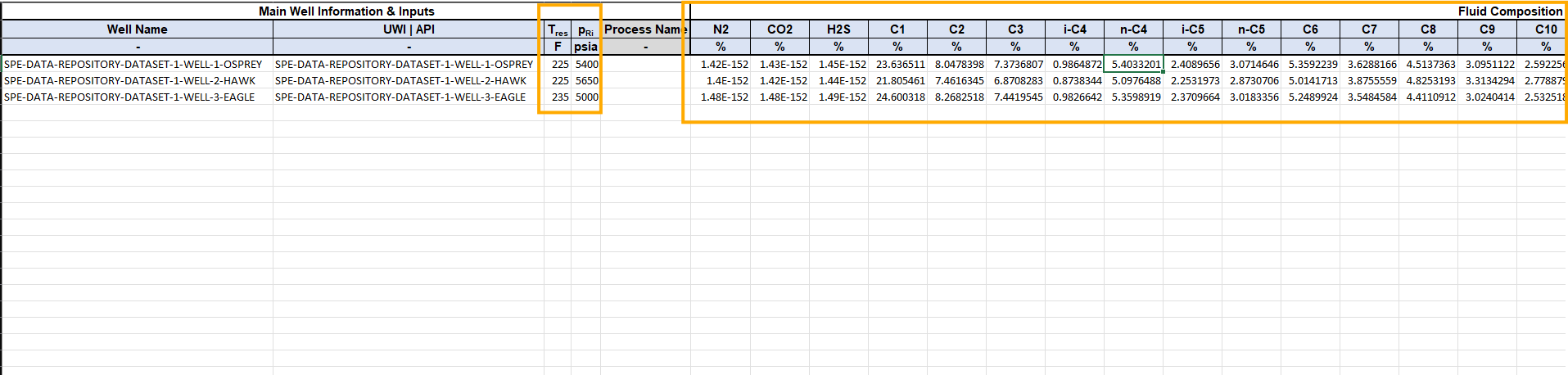
-
Upload the file: Go to Wells, MASS UPLOAD, WHITSON, click "Upload Excel file (.xlsx)", and "SAVE".
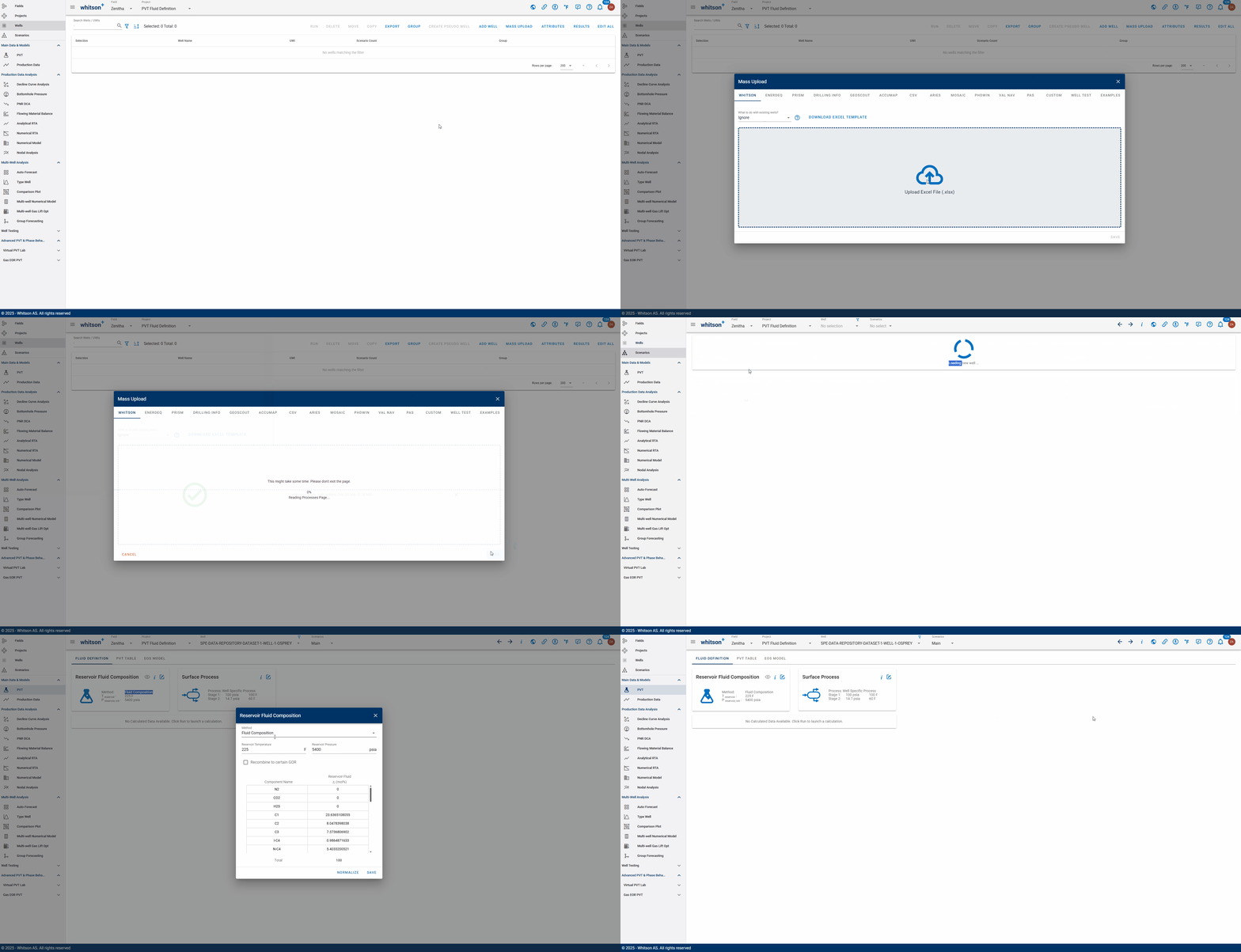
-
Bulk Run: Go to Wells, select the wells, click RUN, click "PVT", then click Yes.
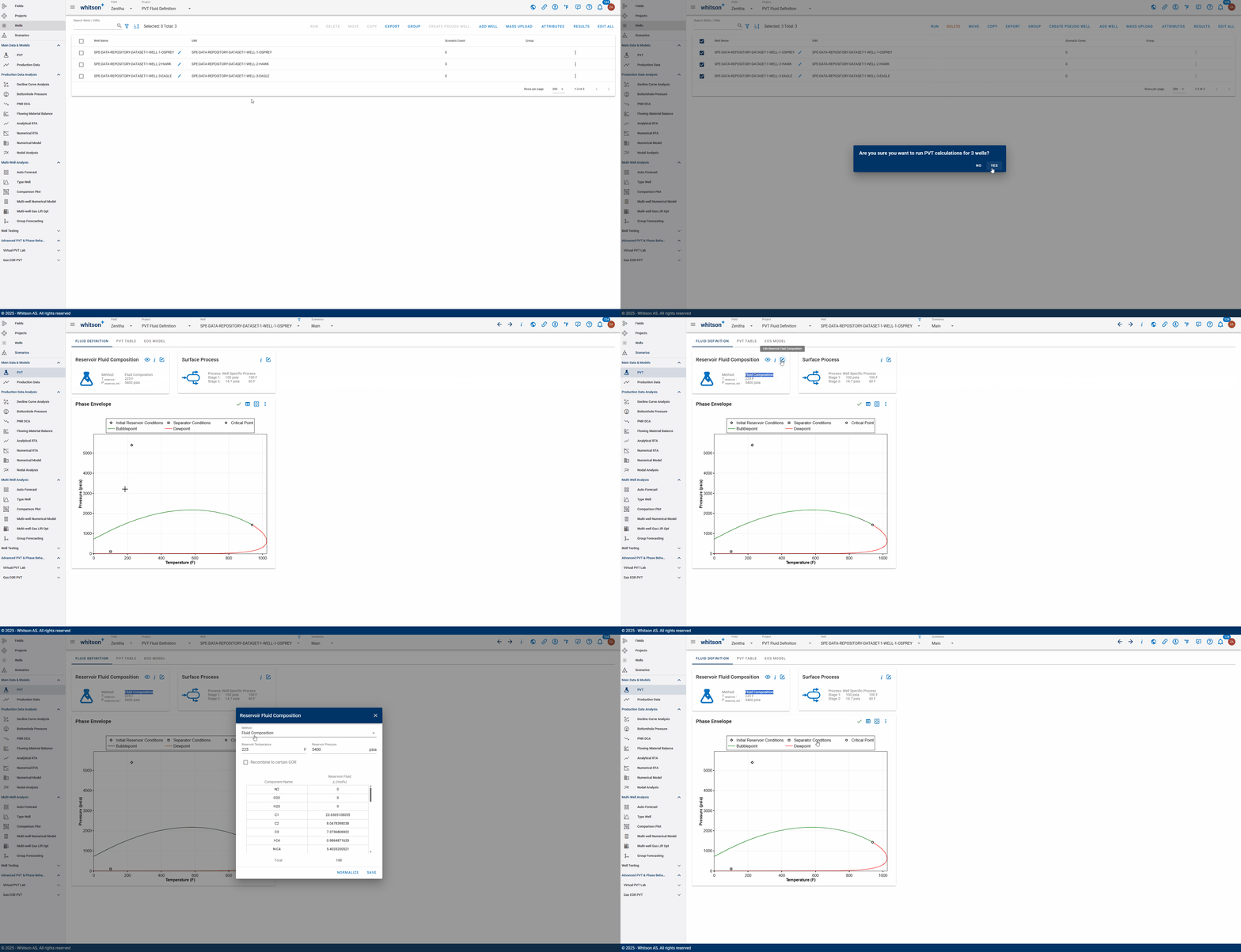
-
Bulk Export: Go to Wells, select the wells, click EXPORT, click "Well Information Data", check the boxes for "Well names", "Fluid Data at Initial Reservoir Conditions", and "Fluid Composition", then click EXPORT.
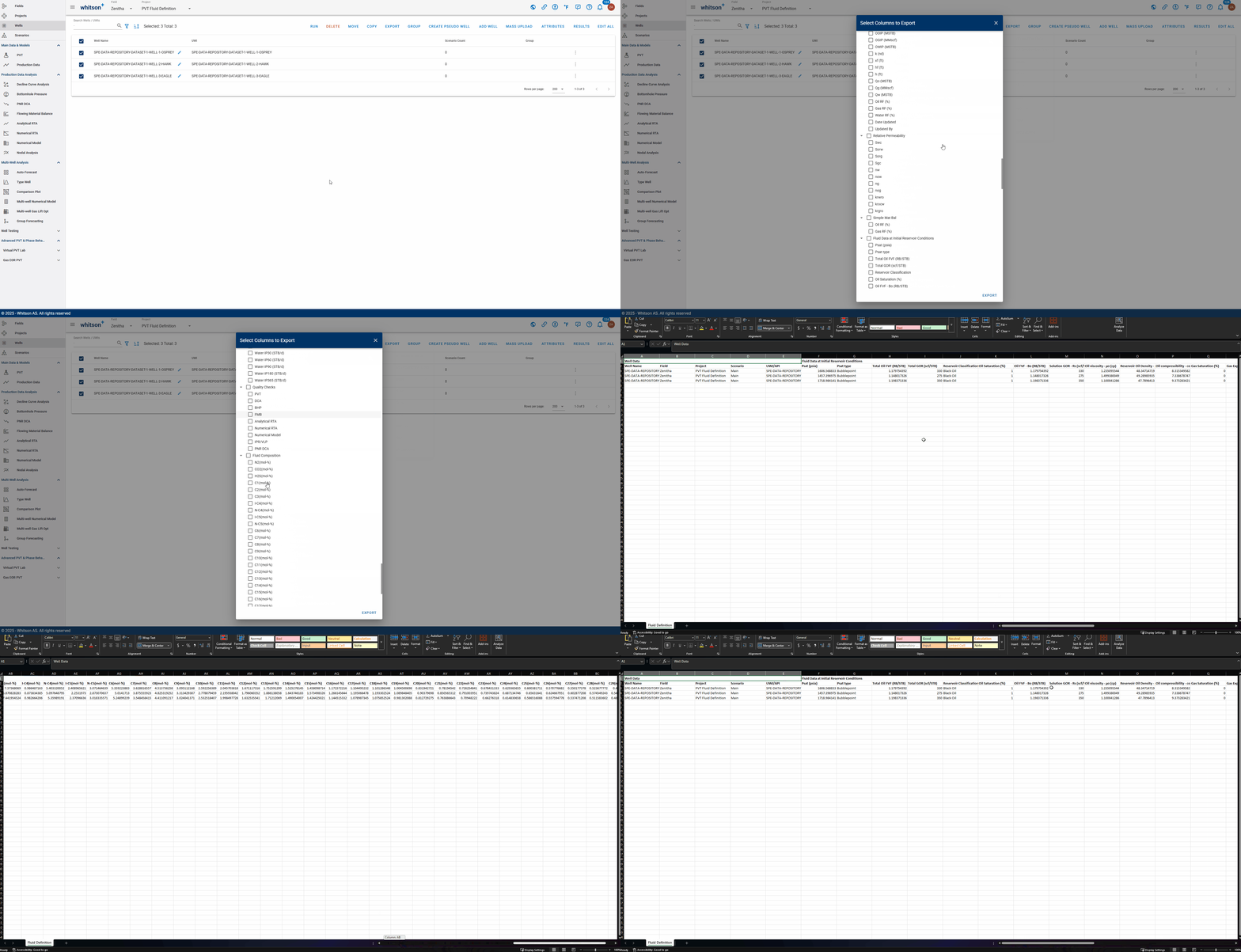
-
An Excel file will be generated with all the PVT properties for the selected wells.
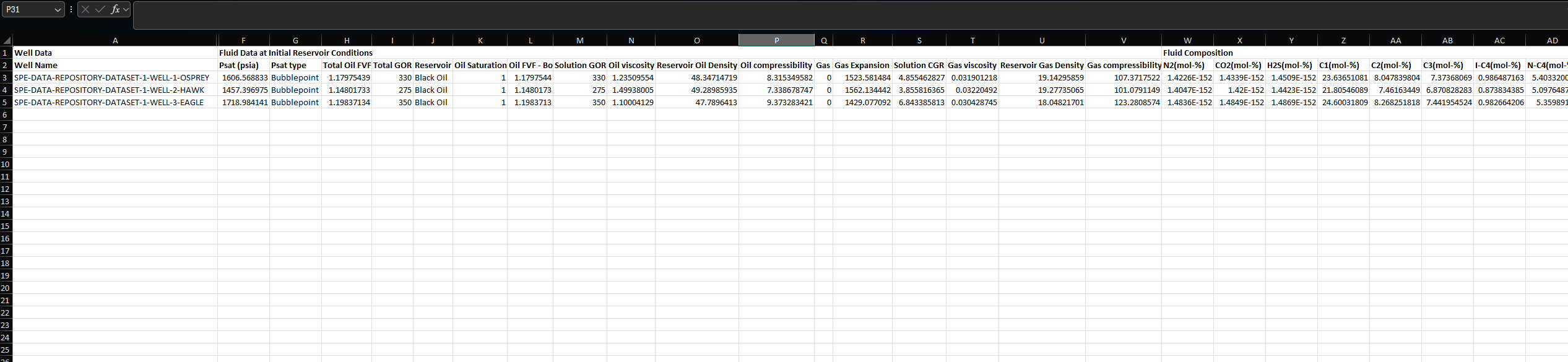
Reservoir Fluid Composition Method
Using the hidden sheet "Well Data (Full Compositions)" to upload wells will set the fluid composition to "Fluid Composition" by default. Using the other Well Data sheets will set the fluid definition method to the corresponding method.
11. Wellstream Composition Estimation
11.1. Introduction
The following table summarizes the methods and their required input data. See Carlsen et al. for a comparative study of the different methods.
Every method requires an Equation of State (EOS) model and a seed feed composition, and the chosen method will largely depend on the data available to estimate the wellstream composition.
| Available Data | Method |
|---|---|
| GOR | Regression on Fg |
| GOR and API gravity | API Interpolation / Fg regression |
| GOR and Saturation Pressure | PSAT Interpolation / Fg regression |
| Comprehensive separator data GOR, MW, separator gas composition, and separator oil composition |
SPO Interpolation / recombination |
11.2. Seed Feed Compositions
A seed feed composition serves as an initial estimate of the actual wellstream composition. Any EOS model in whitson+ must contain a set of seed feed compositions applicable to the given field/basin. Seed feeds are required to estimate the actual wellstream composition with limited PVT data (see whitson+ wellstream estimation methods below). Seed feed compositions can either be actual sample compositions collected from a given field/basin or synthetically generated compositions honoring the trends of actual measured data such as stock tank oil API, GOR, \(\mathrm{C_{7+}}\) MW, etc.
The seed feed table associated with an EOS model in whitson+ can have a single composition or multiple compositions depending on the complexity of the fluid types in the given field/basin. For example, unconventional reservoirs have a wide range of GOR and API gravity that vary spatially. A single EOS model applicable to the entire basin must contain seed feeds that cover the entire range of expected stock tank oil APIs and GORs. This is to make sure that for any expected values of very limited (yet readily available) PVT data such as GOR and/or API, a reasonable estimate of the actual wellstream composition would be available. This estimate of the actual wellstream (called a seed feed) can then be fine-tuned to honor all measured input data, resulting in the actual wellstream composition.
The accuracy of the calculated wellstream composition depends heavily on the amount and type of the PVT data available for wellstream composition estimation. For this reason, whitson+ offers different wellstream estimation methods (see below) starting from the very basic single-input GOR method to the very complicated separator composition method. These methods give the user complete flexibility to use any/all measured data to get a wellstream composition as accurate as possible.
11.3. Methods
11.3.1. GOR Matching
This is a simplified method using very limited data. It only requires a GOR and a surface process. The GOR can be a separator GOR or a full process GOR. See the note below for more details.
Understanding Process vs. Separator GOR
The GOR can be a separator GOR or a full process GOR.
Procedure:
- Flash all seed compositions \(z_{si}\) at the first-stage separator conditions \((p_1, T_1)\).
- Select the seed composition yielding the separator GOR closest to the input GOR.
- The obtained vapor and liquid compositions from flashing the selected seed composition are respectively named \(y_i\) and \(x_i\).
- Recombine the separator oil composition (\(x_i\)) and separator gas composition (\(y_i\)):
- Use \(z_i\) to calculate the GOR of the mixture \(z_i\).
- Calculate an RMS error (\(\delta_\mathrm{RMS}\)) quantifying the quality of the predictions:
The regression consists of minimizing \(\delta_\mathrm{RMS}\) by changing \(f_g\).
GOR-Constrained Regression
The regression always leads to a composition that matches exactly the measured GOR.
11.3.2. GOR and API Gravity Matching
This wellstream composition estimation method is a simplified method used when limited field data is available: GOR and stock tank oil API gravity. The input GOR can be a (total) process GOR or GOR from the first-stage separator, see this note for more details. Optionally, the user can also specify the amounts of non-hydrocarbons (when available) for an accurate description of these components in the calculated composition.
Procedure:
- Replace non-hydrocarbons in all seed compositions \(z_{si}\) if the user has specified these values.
- Flash all the seed compositions \(z_{si}\) from step 1 through the input process conditions. Calculate the corresponding API and GOR for each seed composition.
- Select the two seed compositions that bracket the input API.
- Interpolate between the two selected seed compositions to exactly match the input API.
- Flash the interpolated composition (step 4) at the first-stage separator conditions. The obtained separator gas and oil compositions are respectively named \(y_i\) and \(x_i\).
- Recombine the separator oil composition (\(x_i\)) and separator gas composition (\(y_i\)):
- Replace the non-hydrocarbons in the calculated \(z_i\) from step 6 with user-specified values.
- Use \(z_i\) from step 7 to calculate the first-stage separator GOR and (total) process GOR and stock tank liquid API gravity using the user-specified surface process. The \(z_i\) will match the input (process or separator) GOR and liquid API gravity exactly along with the non-hydrocarbons (if specified).
Input Data-Constrained Regression
This method always leads to a composition that matches exactly the input data: GOR, API gravity, and non-hydrocarbons (when available) except when the input API gravity is outside the range of APIs in the table of seed compositions.
11.3.3. GOR and PSAT Matching
This wellstream composition method is similar to the API-GOR method. The method is used when the GOR and saturation pressure are known for the wellstream composition either from PVT lab measurements or from production data analysis. The input GOR can be a (total) process GOR or GOR from the first-stage separator, see this note for more details. Optionally, the user can also specify the amounts of non-hydrocarbons (when available) for an accurate description of these components in the calculated composition.
Procedure:
- Replace non-hydrocarbons in all seed compositions \(z_{si}\) if the user has specified these values.
- Flash all the seed compositions \(z_{si}\) from step 1 through the first-stage separator of the input process conditions. Calculate the corresponding separator oil and separator gas compositions of all seed compositions.
- Recombine the calculated separator oil and separator gas for each seed composition from step 2 to match the input (separator or total) GOR, yielding new (modified) seed compositions honoring the input GOR.
- Filter the seed feed table by removing modified seed compositions calculated in step 3 that yield no (or unrealistic) saturation pressures at the input reservoir temperature.
- Select the two seed compositions that bracket the input saturation pressure.
- Interpolate between the two selected seed compositions using a variable F.
- Flash the interpolated composition (step 6) at the first-stage separator conditions. The obtained separator gas and oil compositions are respectively named \(y_i\) and \(x_i\).
- Recombine the separator oil composition (\(x_i\)) and separator gas composition (\(y_i\)): where Fg is the second variable.
- Replace the non-hydrocarbons in the calculated \(z_i\) from step 8 with user-specified values.
- Calculate saturation pressure and GOR for the calculated \(z_i\) using the input reservoir temperature and surface process.
- Regress on the two variables, i.e., F and Fg, to match the target PSAT and GOR.
- The \(z_i\) calculated after regression will match the input (process/total or separator) GOR and saturation pressure exactly along with the non-hydrocarbons (if specified).
Input Data-Constrained Regression
This method generally leads to a composition that matches exactly the input data: GOR, PSAT, and non-hydrocarbons (when available) except when the input saturation pressure is outside the range of saturation pressures in the table of seed compositions calculated in step 4. In very few cases, generally for a combination of very low saturation pressures (i.e. less than 2500 psia) and very high GORs (i.e. greater than 25000 scf/STB), the inputs may not be matched depending on the fluid systems used to develop the EOS model. In that case, the user should either review the inputs or contact our support team.
11.3.4. Comprehensive Separator Data Matching
This wellstream composition estimation method requires the following separator data:
- Separator \((p, T)\) conditions
- Separator GOR (see this note for more details)
- Separator oil (SPO) & gas (SPG) compositions (up to \(\mathrm{C_{7+}}\))
- \(\mathrm{C_{7+}}\) average MW of separator oil and gas
- (Optional) Stock tank liquid API gravity
When is stock tank liquid API important?
It is important to note that the stock tank liquid API referred to here is the API measured on the stock tank oil from the single-stage (atmospheric) flash of the collected separator oil in the PVT lab. The calculated composition without stock tank liquid API input should be accurate if the \(\mathrm{C_{7+}}\) of separator oil is reliable from the PVT lab. If the lab-reported separator oil \(\mathrm{C_{7+}}\) is not reliable, then we recommend that users specify the measured stock tank oil API. In that case, whitson+ will estimate the \(\mathrm{C_{7+}}\) molecular weight honoring the input API. The estimated \(\mathrm{C_{7+}}\) molecular weight is then used to extend the \(\mathrm{C_{7+}}\) composition to EOS \(\mathrm{C_{N+}}\) (e.g. \(\mathrm{C_{36+}}\)).
Why does whitson+ need separator oil \(\mathrm{C_{7+}}\) molecular weight when the user inputs stock tank liquid API?
Separator oil \(\mathrm{C_{7+}}\) molecular weight is used in whitson+ for two different purposes: (i) converting the lab-reported molar composition to lab measured mass composition and (ii) extending the \(\mathrm{C_{7+}}\) composition to EOS \(\mathrm{C_{N+}}\) (e.g. \(\mathrm{C_{36+}}\)). If the lab \(\mathrm{C_{7+}}\) is not reliable, this would mean that the lab-reported molar composition of separator oil up to \(\mathrm{C_{7+}}\) is wrong because the wrong (unreliable) \(\mathrm{C_{7+}}\) molecular weight was used to convert the reliable measured mass composition to the reported molar composition. Therefore, lab \(\mathrm{C_{7+}}\) molecular weight is always needed (and used) to convert the lab-reported molar composition back to measured mass composition up to \(\mathrm{C_{7+}}\). For (ii), the lab-reported \(\mathrm{C_{7+}}\) molecular weight is used if stock tank oil API is not input; otherwise, the estimated \(\mathrm{C_{7+}}\) molecular weight is used, honoring the input API.
Procedure without stock tank liquid API:
- Convert the input molar composition of SPO to mass composition (up to \(\mathrm{C_{7+}}\)).
- Flash all seed feeds at the given first-stage separator conditions to calculate SPOs.
- Normalize all SPOs to \(\mathrm{C_{7+}}\).
- Calculate a new set of SPOs by adding the \(\mathrm{C_{6-}}\) mass distribution of input SPO from (1) to the \(\mathrm{C_{7+}}\) mass distributions of all SPOs from (3).
- Calculate the \(\mathrm{C_{7+}}\) MW of all SPOs from (4).
- Select two SPOs from (5) that bracket the input SPO \(\mathrm{C_{7+}}\) MW.
- Interpolate the two selected SPOs to get a single SPO composition matching the input \(\mathrm{C_{7+}}\) MW exactly.
- Use an exponential molar distribution model with input SPG \(\mathrm{C_{7+}}\) MW to calculate the extended SPG molar composition (honoring the input \(\mathrm{C_{6-}}\) molar amounts and total \(\mathrm{C_{7+}}\) molar amount of SPG).
- Recombine the interpolated SPO from (7) and extended SPG from (8) to match the input GOR exactly at the given first-stage separator conditions.
Procedure with stock tank liquid API:
- Same as steps 1-4 from Procedure without stock tank liquid API presented above.
- Perform a single-stage flash of all SPOs to calculate STO API. (Standard conditions, i.e., 14.7 psia and \(60^\circ F\), are used to do the flash. Some labs may measure API by doing a single-stage flash at a temperature different from \(60^\circ F\).)
- Select two SPOs from (2) that bracket the input API.
- Interpolate the two selected SPOs to get a single SPO composition matching the input API exactly.
- Use an exponential molar distribution model with input SPG \(\mathrm{C_{7+}}\) MW to calculate the extended SPG molar composition (honoring the input \(\mathrm{C_{6-}}\) molar amounts and total \(\mathrm{C_{7+}}\) molar amount of SPG).
- Recombine the interpolated SPO from (4) and extended SPG from (5) to match the input GOR exactly at the given first-stage separator conditions.
Warning
The estimated wellstream composition when flashed to the input first-stage separator conditions will yield the input GOR exactly. There might be deviations in the calculated separator oil and separator gas compositions and SPO \(\mathrm{C_{7+}}\) MW (or stock tank liquid API) when compared to the input data, mainly depending on whether the separator samples were in equilibrium at the given separator conditions.
11.4. References
[1] Carlsen M., Dahouk, M., Mydland, S. and Whitson C., Compositional Tracking: Predicting Wellstream Compositions in Tight Unconventionals, IPTC-19596-MS, Society of Petroleum Engineers, 2020.