Minimum Miscibility Pressure (MMP)
1. Generating an MMP Calculation
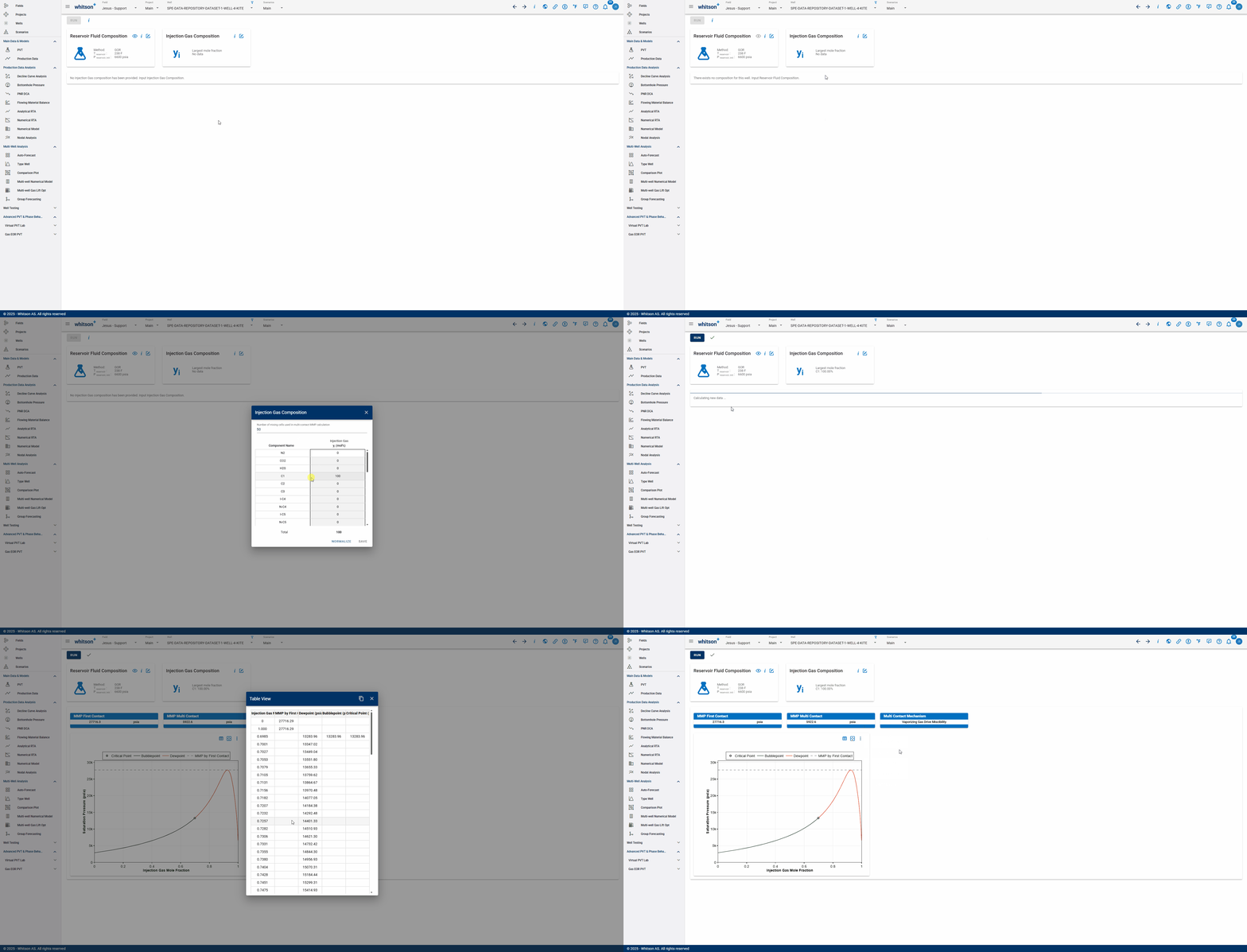
The Minimum Miscibility Pressure (MMP) module calculates both first-contact miscibility pressure () and multi-contact miscibility pressure () based on the selected reservoir fluid and injection gas compositions.
The required inputs are:
1.1. Reservoir Fluid Composition
Select the reservoir fluid composition to be used in the MMP calculation. The composition can be generated using any of the available fluid definition methods described in the Fluid Definition section.
The following reservoir fluid inputs are required:
- Initial reservoir fluid composition.
- Initial reservoir pressure.
- Reservoir temperature.
1.2. Injection Gas Composition
Define the injection gas composition that will be used for the miscibility calculation.
The following injection gas inputs are required:
- Number of mixing cells used for the multi-contact MMP calculation.
- Injection gas mole percentage for each relevant component.
The injection gas composition should be entered for all relevant components, such as , , , , , , , , , , and heavier hydrocarbon fractions as applicable.
2. Terminology
2.1. Miscibility
In petroleum engineering, miscibility describes the condition where the injected gas and reservoir fluid can mix and form a single hydrocarbon phase at a given pressure and temperature.
Two miscibility concepts are commonly used:
- First-contact miscibility (FCM): miscibility occurs immediately when the injection gas and reservoir fluid contact each other.
- Multi-contact miscibility (MCM): miscibility develops gradually through repeated contacts between the injection gas and reservoir fluid during the displacement process.
First-contact miscibility is commonly used to evaluate gas huff-n-puff (HnP) processes, where the injected gas contacts the reservoir fluid near the wellbore during injection and soaking. Multi-contact miscibility is more commonly associated with gas flooding or displacement processes, where the injected gas continuously interacts with reservoir fluid as it moves through the porous medium.
2.2. First-Contact Miscibility
At a given pressure and temperature, first-contact miscibility occurs when two fluids mix in all proportions and form a single phase, regardless of the relative amount of each fluid. This is the formal definition of miscibility.
In petroleum systems, the first-contact miscibility pressure (FCMP) is the pressure at which the injection gas and reservoir fluid become miscible immediately upon contact. The minimum first-contact miscibility pressure () is the lowest pressure at which this condition is achieved.
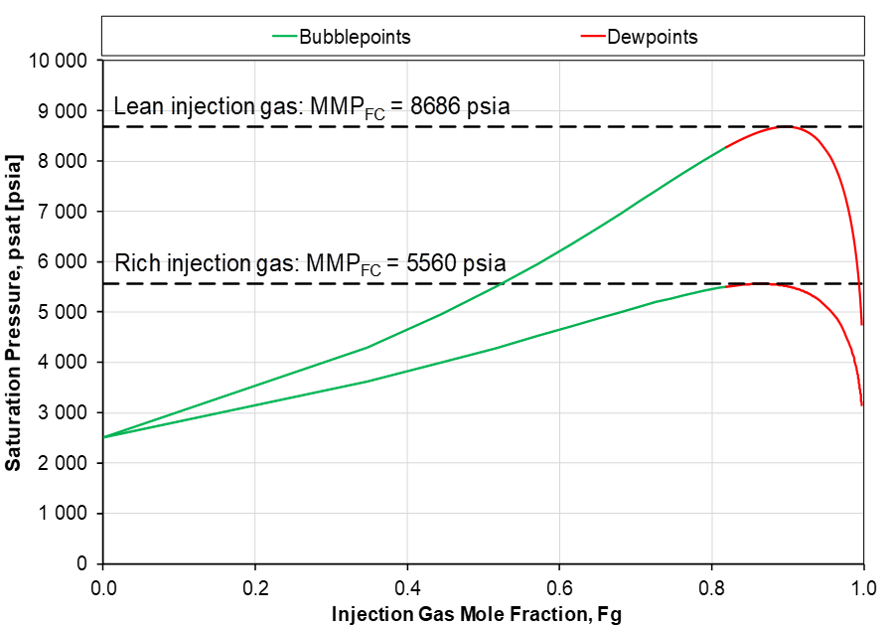
The is determined from a swell test. The result can be interpreted from a pressure-composition (-) diagram, where the saturation pressure is plotted against the mole fraction or molar percentage of injection gas. The maximum saturation pressure on the - curve corresponds to .
The figure below illustrates this concept for both rich and lean injection gases.
2.3. Multi-Contact Miscibility
In a conventional gas displacement process, miscibility does not always occur immediately on first contact. Instead, it can develop progressively as the injection gas repeatedly contacts the reservoir fluid while flowing through the reservoir.
During this process, components are exchanged between the gas and liquid phases through vaporization and condensation mechanisms. These compositional changes are controlled by phase behavior, equilibrium ratios, and the local fluid composition along the displacement path.
The injection gas and reservoir fluid are considered multi-contact miscible (MCM) when repeated contacts between the two fluids eventually create a miscible transition zone. This condition is represented by the multi-contact minimum miscibility pressure ().
Multi-contact miscibility is therefore a dynamic miscibility process. It describes the mixtures that form as phases with different compositions move through porous media at different velocities and repeatedly interact with each other.
2.4. Minimum Miscibility Pressure
For a given reservoir temperature, reservoir fluid composition, and injection gas composition, the Minimum Miscibility Pressure (MMP) is the lowest pressure at which miscibility can be achieved between the injected gas and the reservoir fluid.
Miscibility can occur through different mechanisms, including:
- First-contact miscibility, represented by
- Multi-contact miscibility, represented by
First-contact miscibility occurs when the injected gas and reservoir fluid become miscible immediately after contact at a given pressure. Multi-contact miscibility occurs after repeated contacts between the injected gas and reservoir fluid, where compositional changes through vaporization and/or condensation allow the fluids to become miscible.