Common process conversion
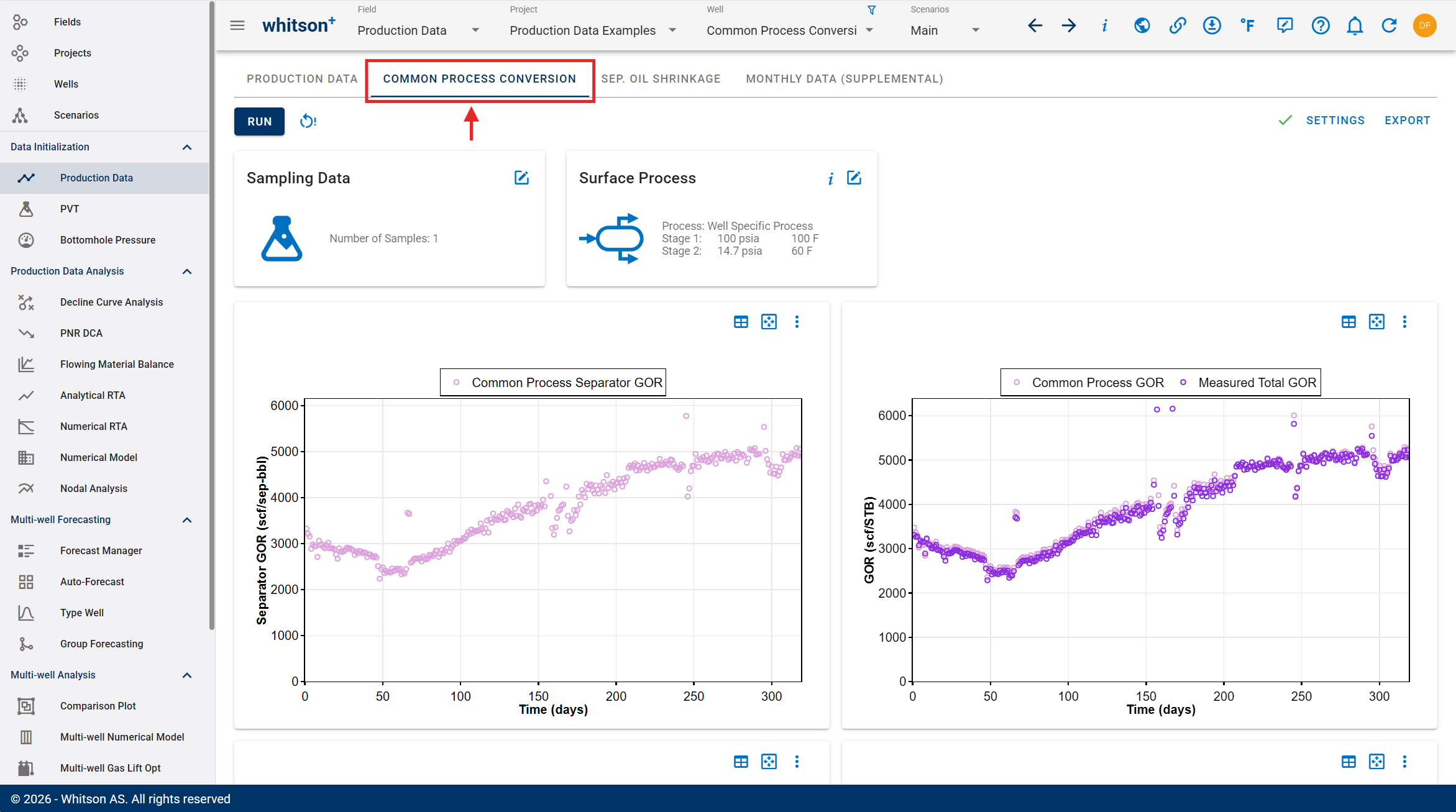
The separator production data and daily wellstream compositions are used to calculate daily values for:
- Common process separator GOR
- Common process GOR
- Common process rates
The common process rates are the rates that should be used when modeling the well's history.
Note
Common Process refers to rates and GORs that are reprocessed through a fixed separator process.
Common Process Conversion - What is It?
Black oil tables are generated assuming a fixed surface process, but in reality separator conditions change over time. Hence, there is a risk of inconsistencies between the rates used in history matching (which assume constant separator conditions) and the actual measured rates (which reflect changing separator conditions in the field). If separator conditions at the surface are changing significantly over time, a “correction” to convert rates to a set of constant separator conditions might be needed for:
- Consistent well-to-well performance comparison
- Consistent usage of black oil tables in history matching (using RTA/PTA or res. simulation)
- Consistent analysis of CGR performance over time
This correction is referred to as a common process conversion, because we “convert” the rates processed through changing separator conditions to a "common process".
Want to know more? Here is a presentation on common process conversion.
What is the difference between shrunk rates and common process rates?
First, both of these represent a conversion of rates from separator conditions to stock tank conditions.
Shrunk Rates
Here, we take the actual separator conditions at every point in time (separator pressure and temperature) and use them to calculate what the oil and gas volumes would be at stock tank conditions.
Best for: matching real production/sales numbers.
Common Process Rates
Here, the changing separator conditions are only used to determine what the fluid coming from the well looks like (the flowing wellstream).
After that, we ignore the changing surface setup and always process the fluids through a single fixed separator process, the same one used to generate the PVT and black oil tables.
That is why we call it the "common process".
So, the rates are always calculated using a consistent surface setup.
Best for: engineering workflows and simulation, as it ensures consistency with PVT data.
In its simplest form
-
Shrunk Rates:
“Use the separator conditions from that day for actual sales/allocation.” -
Common Process Rates:
“Pretend the plant conditions were always the same for engineering consistency.”